AICC answers calls with anything that speaks the OpenAI Realtime protocol. In the first post in this series that meant a hosted model, or Cascade Realtime Gateway, which runs ASR → LLM → TTS behind the protocol but still calls hosted providers for each stage. The question this post answers: can one Mac run the whole cascade itself, every model local, and still answer inside the deadlines AICC’s client enforces?
For one call, yes. On an M3 Max, from the end of the caller’s speech to the
first audio sent, P50 is 1.37–1.39 s and P95 1.52–1.54 s
on turns the turn detector judged complete, and
every one of AICC’s windows had more than 2 s of margin. For
three calls, not reliably. The TTS synthesizes one stream at a time,
and at three sessions one answer’s first audio came
3.39 s after response.created, past AICC’s 3 s limit.
What runs where#
mlx-realtime speaks a documented subset of the OpenAI Realtime API (GA) over
WebSocket at /v1/realtime, and the official openai Python
SDK connects by changing only base_url. AICC
attaches through its existing gateway profile, with no AICC change.
Inside, it is four processes:
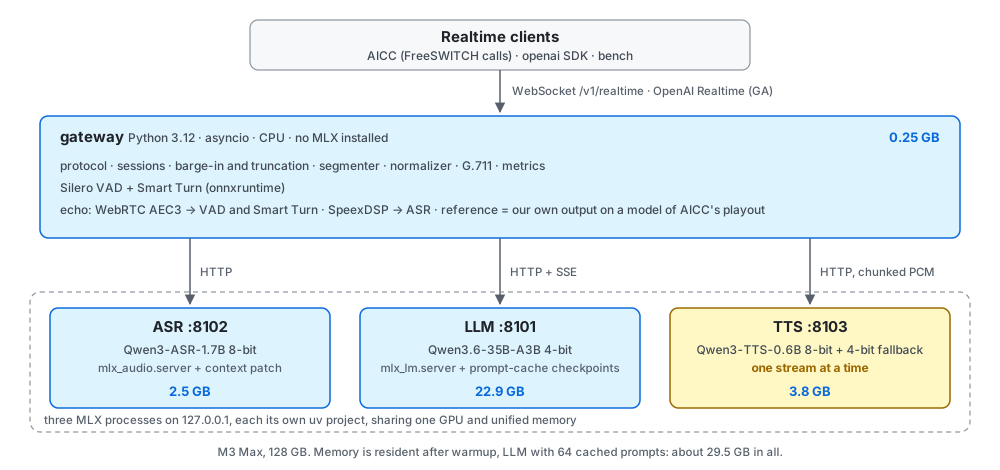
- The gateway, Python 3.12 and asyncio, owns the protocol, sessions,
echo cancellation, Silero VAD and Smart Turn, segmentation and barge-in.
Its environment has no
mlxpackages installed, so it cannot load an MLX model by construction; Silero and Smart Turn run on the CPU under onnxruntime. - Three MLX backends on localhost, each its own uv project:
Qwen3-ASR-1.7B 8-bit, Qwen3.6-35B-A3B 4-bit under
mlx_lm.server, and Qwen3-TTS-0.6B CustomVoice 8-bit with its 4-bit build as the fallback, every one pinned by revision.
Resident after warmup on the real stack: LLM 22.9 GB with 64 cached prompts, TTS 3.8 GB, ASR 2.5 GB, gateway 0.25 GB, about 29.5 GB in all, more than the README’s “about 25 GB”.
Cascade Realtime Gateway is “a design reference only, not a client of this service”: mlx-realtime reuses its protocol decisions and lessons where they are GA-faithful. The service is sized for development and testing: at most four sessions, because a human call AICC transcribes opens two transcription sessions, one per leg.
The deadlines#
AICC’s client enforces four deadlines:
| From | To | Limit |
|---|---|---|
response.create | response.created | 3 s |
response.created | first audio delta | 3 s |
| one audio delta | the next | under 2 s |
response.created | response.done, for a tool-only reply | 3 s |
What happens when one is missed: “A missed deadline silently abandons the turn.” No error, no retry. AICC also streams caller audio continuously, including while the bot speaks, and has no echo cancellation. Both facts shape everything below.
Where 1.4 seconds goes#
The benchmark replays 126 public utterances (FLEURS Chinese and
English, ASCEND code-switched conversation, 1.6 to 9.9 s each) in 20 ms
frames at real time, with AICC’s own session settings:
server_vad with 500 ms of silence. The machine was
an M3 Max with 128 GB on AC power, High Power mode, nothing else on the GPU.
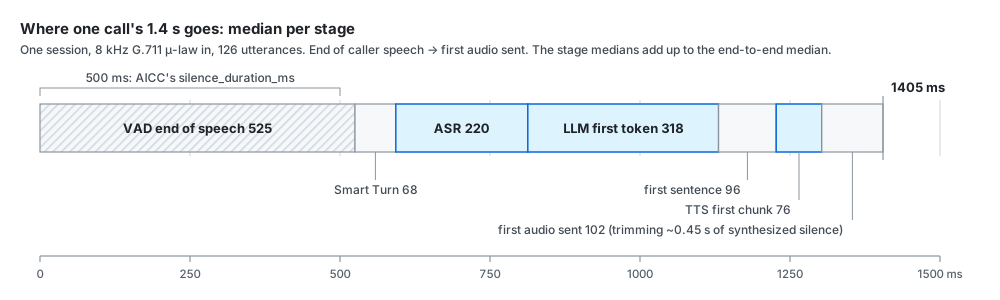
Per stage, one session, on the telephone variant (8 kHz G.711 μ-law in):
- 522–525 ms is the caller’s own silence. The VAD’s end-of-speech
decision is
silence_duration_msplus detection, and AICC asks for 500 ms. More than a third of the wait is a setting the client chose. - The models take about 610 ms: ASR 220 ms, LLM first token 318 ms, TTS first chunk 76 ms.
- The ~100 ms of
first_audio_sentis silence. Qwen3-TTS puts about 0.45 s of silence before every segment; the TTS synthesizes it and the trimmer drops it.
The sum of the stage medians matches the end-to-end median. The P95 is another story. Over all turns it is 3.78 to 3.87 s, because Smart Turn held 12–13 turns per run as incomplete until its 3 s ceiling. Ten of those are ASCEND excerpts that really do stop mid-sentence (“我认为现在的AI,比如说在。”). That is why the headline figures are quoted on turns that ended on a complete verdict, n = 113–114 per run.
Fitting the LLM into 3 seconds#
The median turn is the easy case. The hard ones are AICC’s phase changes:
the flow swaps the instructions, then the caller asks to be transferred, and
the model has to emit a transfer_to_agent call inside the tool-only
window.
Qwen3.6 is hybrid, Gated DeltaNet plus attention, so its cache cannot be
trimmed back. mlx_lm.server can reuse only whole prefixes it
saved, so each of AICC’s phase changes re-prefilled about 1650 tokens.
The LLM backend now saves checkpoints where the tool definitions end
and where the system message stops matching recent ones, so a phase change
prefills ~190 tokens, not ~1650. Together with warming the
prefix before the caller’s next turn,
median prefill fell from 1625 tokens to 47 on a cold call, and from 1711 to 123 on AICC’s turn after a tool result.
Measured on the LLM alone (mock ASR and TTS, one call at a time,
20 runs per case, so p95 is the maximum), from response.created to the
first sentence boundary or, for a tool-only reply, to response.done:
| Case | Before: no warming, stock cache (p50 / p95 s) | Checkpoints + warming |
|---|---|---|
| A cold call, new instructions | 1.32 / 1.38 | 0.41 / 0.49 |
| Transfer after an instructions change (tool-only) | 2.89 / 3.46 | 1.50 / 1.88 |
| AICC’s reply to a tool result (spoken) | 1.48 / 1.80 | 0.52 / 0.64 |
| AICC’s next turn is a transfer (tool-only) | 3.02 / 4.29 | 1.53 / 2.08 |
Without them, transfers missed AICC’s 3 s window at p95 even before the ASR was counted. With both changes, every case is inside it at p95, the tightest at 2.17–2.58 s with ASR.
The other LLM problem was not latency. In M0,
11% of realistic transfer turns ended with finish_reason: tool_calls and no parsed call:
Qwen3.6 writes <transfer_to_agent> instead of <function=transfer_to_agent>.
The LLM backend now
rewrites that form for tools the request declared, and never for undeclared names.
Live, 60 of 60 transfers were delivered, 4 of them recovered that way.
The third call#
The TTS server serves streams strictly one at a time. In M0, with two concurrent requests the second waited 2.9 s for its first chunk; with four, the last waited 8.4 s. The LLM batches and the ASR takes four at once, so the TTS queue is the capacity limit of bot calls.
The gateway shares it as well as it can. The queue is earliest-deadline first: the session that will run out of audio soonest goes next. An audio reserve holds back up to 1.5 s of synthesized audio and releases it a delta at a time, to keep AICC’s 2 s gap watchdog fed. That was not enough. In the two-session run one answer’s second segment waited 2.3 s behind another session’s long segment, and the wire went quiet for 2092 ms: AICC would have abandoned the turn. Now, when the reserve runs dry and more audio is coming, the gateway sends 20 ms of silence every second. In the three-session soak, 23 responses were bridged that way and no gap exceeded 1.0 s.
Then the first-audio window, the one that does not bend:
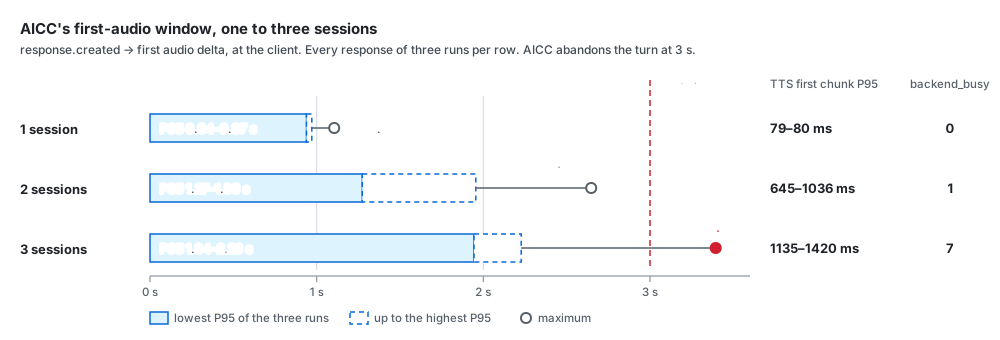
Across three runs per configuration, the medians barely move. The tails are the TTS queue:
- TTS first chunk, P95: 79–80 ms at one session, 645–1036 ms at two, 1135–1420 ms at three. A segment of N seconds of speech holds the TTS for about N/4 s, and the second segment of a one-sentence answer is often 6–9 s of speech.
- End to end, complete verdicts, P95: 1.52–1.54 s at one, 2.53–2.78 s at three.
- Failures: 7 responses at three sessions failed with
backend_busy, 1.8%: their segment waited in the queue more than 2 s past its deadline. - AICC’s window: one first audio at 3.39 s, of which 1.92 s was the TTS queue, and one failed response at 3.22 s. AICC would have abandoned both.
The bench is also busier than a call: each session talks without a pause. That makes the three-call numbers pessimistic, not wrong.
The shared GPU makes it worse, and merging processes would not help. While the LLM decodes, the TTS’s real-time factor rises from 0.25 to 0.33–0.38. While the LLM prefilled ~16k tokens it reached 2.08, half real time, and any session speaking then would starve. AICC’s prompts are ~1.6k tokens, a tenth of that. And merging the three model processes into one would fix nothing: “the capacity limit is the TTS stream itself”.
What would help is
more TTS capacity or shorter waits: a second TTS process (a code
change, since the provider takes one base_url), mlx-audio’s batched
generation, capping continuation segments so none holds the TTS for more
than about a second, or a longer queue timeout now that the keepalive feeds
the watchdog. None is done yet.
The service hears itself#
Echo on these calls is mlx-realtime’s problem.
Neither AICC nor FreeSWITCH cancels it, and the server cancels
its own response when it hears the caller, so it “would therefore interrupt
itself on its own echo, and AICC’s 800 ms barge guard cannot prevent that”.
On simulated telephone echo with no canceller,
Silero fired on 75% of echo-only windows: 1005 false speech_started in 96 calls.
One canceller could not serve both consumers. On simulated G.168 echo paths:
- WebRTC AEC3 keeps the VAD quiet, but its suppressor removes quiet caller speech. Offline, in continuous double talk at −15 dB, it cost the English ASR +28.4 points of WER.
- SpeexDSP’s linear canceller keeps the caller intelligible, but its residual triggers the VAD: 0 of 96 calls kept the VAD quiet on echo alone.
So each session runs both: AEC3 in front of Silero and Smart Turn, Speex with its preprocessor in front of the ASR. The reference for both is the bot’s own output, placed on a model of AICC’s playout. Through the gateway’s own path, still on simulated echo, the dual path kept double-talk error within its limits in all 8 cells: the worst was continuous double talk at −15 dB, +1.8 points in Chinese and +1.6 in English, against +13.7 and +33.2 for AEC3 alone.
A line without echo is its own failure. AEC3’s suppressor then takes a caller who talks over the bot for echo, and silenced them by up to 44 dB, so barge-in came 2.5–3.4 s late or not at all. AEC3 is now bypassed after 1.5 s of playing with no echo seen. The first version of that bypass let chance correlation peaks in the caller’s own speech turn it back on; requiring three agreeing windows cut false resumes from 29 to 2, and the SDK barge-in on the real stack from 1503 ms to 539 ms.
I have since run real calls through AICC and FreeSWITCH: the bot did not cut itself off on its own echo, and the ASR kept up. That is an observation, not a measurement.
What I am not claiming#
- Live echo numbers. Every echo figure above is on simulated G.168 echo paths. The real calls were observed, not measured: there is no echo path, ERL, delay or double-talk number from a real line, and the repository still lists that measurement as deferred.
- Recorded phone calls. The latency corpus is public read speech and conversation excerpts sent through a telephone codec, and the bench plays nothing back, so it has no echo.
- One code version. The one-, two- and three-session runs ran on
bb75826plus a working tree that gained fixes between runs. - Statistics. One machine, one run per audio variant, three variants per session count, no confidence intervals on latency.
- Approved targets. The per-stage budget and the latency targets are proposed, not approved.
- Capacity. One call meets AICC’s deadlines;
three do not reliably. Two calls sit in between: one
backend_busyand the one 2 s gap that led to the keepalive silence. Two calls have not been rerun since. - A comparison with Cascade or a hosted model. Different datasets, different networks, different hardware.
- Production. The service is sized for development and testing. WebRTC and SIP transports, Docker, multiple machines and persistence are out of scope.
Run it#
On an Apple Silicon Mac with roughly 30 GB of memory to spare, from the README:
make models-mlx     # once: the pinned MLX models, ~25 GB of downloads
make dev            # the backends and the gateway, on 127.0.0.1:8000
make bench          # the latency and ASR report against the running gateway
Then point any Realtime client at it, as the README’s SDK example does:
client = AsyncOpenAI(base_url="http://127.0.0.1:8000/v1", api_key="local")make bench writes the report whose numbers are above;
LATENCY.md explains how each one is produced.
Code: mlx-realtime · docs/LATENCY.md · docs/ARCHITECTURE.md